Huitzilin takes its name from the Nahuatl word for hummingbird, an animal that occupied a remarkable place in the worldview of our Mexica ancestors.
In the sixteenth-century Florentine Codex, compiled by Bernardino de Sahagún from the knowledge of Nahua informants, the hummingbird is described as becoming almost lifeless during the cold season and later awakening and “coming to life” again. Today we recognize the biological phenomenon underlying this observation as torpor, an extraordinary physiological state in which hummingbirds can drastically reduce their metabolism and body temperature.
The hummingbird also inhabited the boundary between life and death in Mexica thought. Warriors who died in battle or were sacrificed after capture were believed to accompany the Sun and, after four years, to return in the form of hummingbirds and butterflies. Whether observation of the hummingbird’s deathlike torpor contributed to this belief cannot be established. The correspondence, however, is striking.
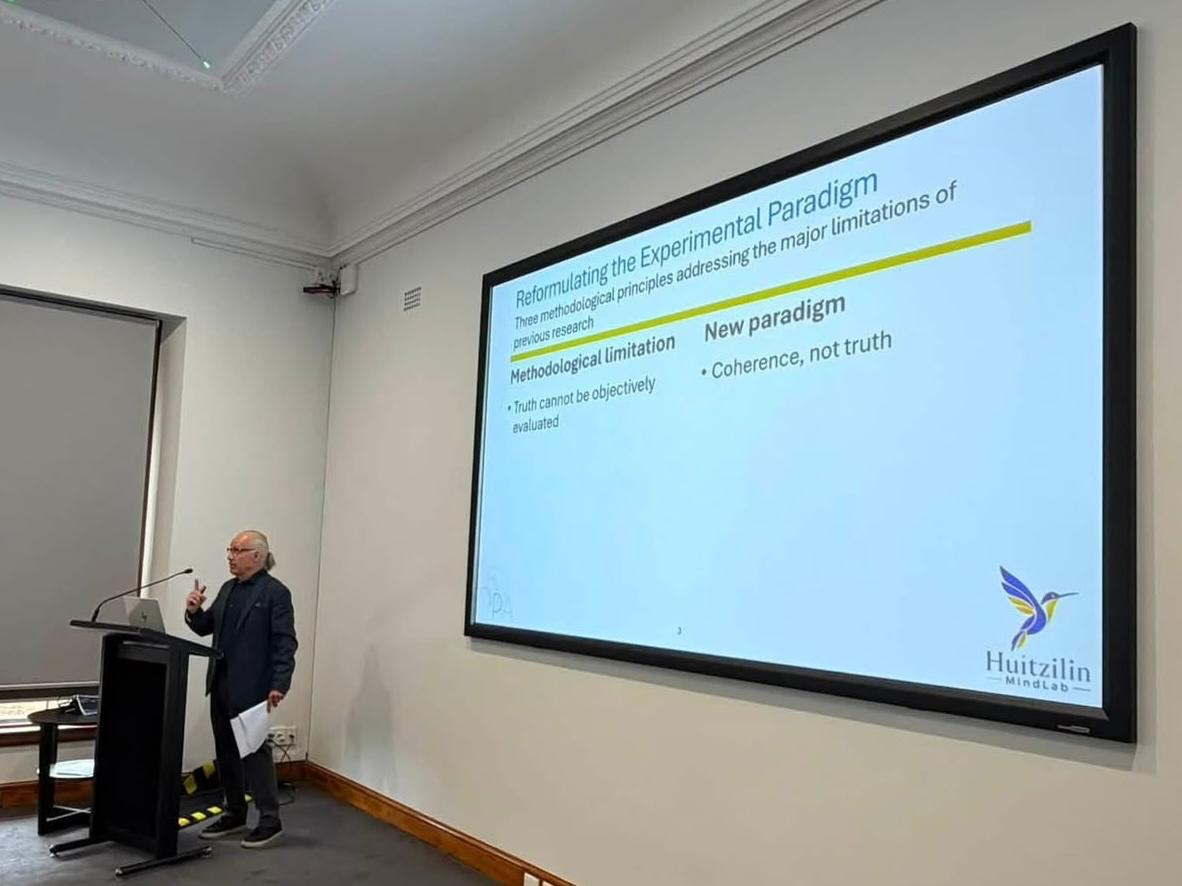
We chose the hummingbird as the symbol of Huitzilin MindLab for a related boundary that remains no less mysterious: that between the material world and mind. Our work explores correspondences between physical processes and subjective experience without presuming in advance whether they represent separate realms or different manifestations of an underlying reality.
The hummingbird thus becomes our messenger between worlds, not as a claim inherited from Mexica cosmology, but as a metaphor inspired by it: a living creature poised between apparently different states, inviting us to investigate what connects them.